Coach Elijah PierreFounder & Chief Coach · TEELCA Global
THE PERSON BEHIND THE PROCESSFaith. Character. Responsible service.
IntegrityEquityInnovationSustainability
01 / THE FOUNDATION
Your value comes before your title.
My coaching starts with the person you are called to be. A goal gives you somewhere to practise that identity; character shapes how you carry the responsibility.
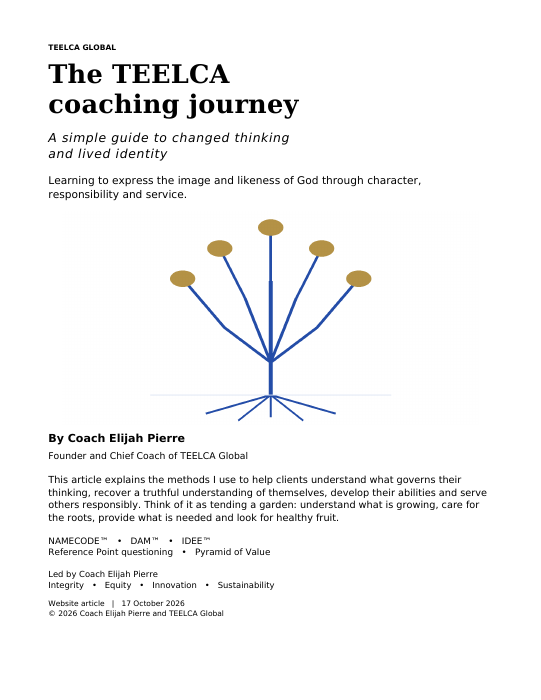
Think of a garden. We notice what is growing, care for the roots, provide what is needed and look for healthy fruit. In the same way, we work with thinking, identity, capability and daily choices.
The Christian foundation of this work +
In my Christian understanding, God is our source and reference point, Christ is our pattern for living, and the Holy Spirit guides our growth. Genesis 1:26–27 connects humanity with God’s image and likeness; Genesis 2:15 joins dignity with responsibility. Romans 12:2 speaks of renewed thinking, and Galatians 5:22–23 describes character fruit.
My priestly lens means tending what is entrusted, protecting life, keeping truthful order and serving responsibly. TEELCA’s named frameworks are modern coaching methods informed by Scripture and Hebrew thought.
02 / THE TEN-STAGE JOURNEY
See how the change takes shape.
Choose a stage to explore its purpose, an everyday example and one practical action. We revisit earlier stages whenever a new need appears.
STAGE 01 / 1001
Awareness
Notice the repeating pattern.
Reference Point questioning · Breaking the Survival Loop™
We begin by noticing what keeps happening. A difficult experience can shape a belief, a reaction and another difficult experience. We describe that pattern without making it your identity.
In everyday life
Maya misses two questions and says, “Everything I do fails.” She hides her work and avoids practice. We notice both her response and any instruction, time or support she needs.
Try this with your coach
Describe one repeating difficulty using facts. What happened, and what did you do next?
What we look forA pattern you can describe clearly, with a practical need you can address.
STAGE 02 / 1002
Deconstruction
Examine the belief beneath it.
DAM™ · Deconstruct
We carefully take the pattern apart. What is a fact? What is an interpretation? We examine the belief against evidence, Scripture, wise counsel and the actual circumstances.
In everyday life
“I missed two questions” is a fact. “I always fail” is a conclusion. Maya learns to separate the mistake from the story she tells about herself.
Try this with your coach
Write the fact beside the interpretation. Ask what evidence supports each, and what skill or support is missing.
What we look forA clearer account of the situation and a belief that can be examined honestly.
STAGE 03 / 1003
Alignment
Choose what should guide life.
DAM™ · Align · The Two Logics lens
We choose a truthful reference point and bring decisions into agreement with it. The Two Logics lens asks whether a choice serves fear and control, or truth, creativity, life and stewardship.
In everyday life
Maya practises saying, “I made mistakes. I can ask for help and practise.” Learning faithfully becomes her priority, so she shows her work and asks one clear question.
Try this with your coach
Choose one truthful response, one action and a date to review it.
What we look forA new direction made visible in a specific, responsible decision.
STAGE 04 / 1004
Identity discovery
Understand the person and responsibility.
NAMECODE™ · The Hebraic Naming Principle
We explore identity in the NAMECODE order: Essence, Nature, Purpose, Function, Designation, Title and Identity. Your dignity is already present; the sequence helps you understand and embody it.
In everyday life
Maya enjoys explaining things. She explores how that capacity can express truth, patience and care through a supervised reading-helper role.
Try this with your coach
Open the seven NAMECODE layers below. Write one honest sentence for each.
What we look forA description of identity connected to real duties, capacity and conduct.
STAGE 05 / 1005
Development
Practise character and competence.
IDEE™ · Develop
Ability becomes dependable through practice and feedback. We develop character alongside competence: what you can do and how you treat people while doing it.
In everyday life
Maya practises a short reading activity with a trusted adult. She improves unclear explanations and learns to pause when she becomes impatient.
Try this with your coach
Practise one needed skill or character habit. Ask someone trustworthy for specific feedback.
What we look forAn improvement that can be seen in your work and relationships.
STAGE 06 / 1006
Equipping
Put tools and support in place.
IDEE™ · Equip
We identify what the responsibility requires: suitable tools, time, training, relationships, permission, authority or a workable system. Support must match the actual need.
In everyday life
Maya needs books, a quiet space, a simple plan and adult supervision. A capable adult may need equipment, clearer authority or protected time.
Try this with your coach
Arrange one missing resource or support before taking the next responsibility.
What we look forA practical barrier removed and a task that can be carried responsibly.
STAGE 07 / 1007
Expression
Use developed ability to serve.
IDEE™ · Express · Pyramid of Value
Expression is where another person experiences the benefit of your developed ability. The Pyramid of Value describes four domains: Hustle, Career, Ministry and Enterprise.
In everyday life
Maya helps with one supervised reading activity. Over time, the same ability might support paid help, a teaching career, community service or an organised learning service.
Try this with your coach
Complete one useful task for someone, within your current capacity and agreed boundaries.
What we look forA real contribution, feedback from the person served and a next improvement.
STAGE 08 / 1008
Stewardship
Care for people and resources.
The Entrepreneur’s Operating System™
We care responsibly for what has been entrusted: time, ability, relationships, money and influence. We examine whether commitments are realistic and people are treated with dignity.
In everyday life
Maya prepares her materials, keeps the agreed schedule and tells the supervising adult when she needs help. An entrepreneur applies the same care to quality, records and promises.
Try this with your coach
Review one commitment. What needs preparation, protection, repair or a more truthful agreement?
What we look forPromises kept, resources cared for and work others can depend on.
STAGE 09 / 1009
Multiplication
Help others carry the contribution.
Leadership development · Legacy
Useful contribution can continue through others. We share a process, develop another person’s capability and gradually share responsibility with appropriate support.
In everyday life
Maya shares a helpful reading activity with another helper. A leader can train someone to use a process and support them as they take responsibility.
Try this with your coach
Explain one useful practice to another person and support them as they try it.
What we look forWisdom or capability passed on responsibly, with growing continuity.
STAGE 10 / 1010
Renewal
Review the fruit and grow again.
Evaluation · Another development cycle
We look at what the journey is producing. A new role may reveal a skill gap or an old fear. We review evidence, repair what needs attention and return to learning.
In everyday life
A larger reading group shows Maya that she needs a different plan. She asks for support, improves the activity and begins another development cycle.
Try this with your coach
Record what helped, what needs repair and the next stage to revisit.
What we look forAn honest review and a practical next step. Growth continues.
The Christian Entrepreneur Transformation Cycle™ supplies the ten-stage structure. Its questions also apply at home, at school and at work. Maya is an illustrative learner, not a client case study.
03 / THE METHODS WORK TOGETHER
One journey. Connected methods.
IDEE™ is the overall development cycle. DAM™ helps change a pattern. NAMECODE™ orders identity discovery. Each method supports the others.
IDEE™
Develop the contribution.
Identify → Develop → Equip → Express
Identify what is present and what is needed. Develop character and competence. Put suitable support in place. Express ability through a useful task.
Identification begins at the start of the journey.DAM™
Change the pattern.
Deconstruct → Align → Manifest
Examine the belief, align with truth and make the change visible through conduct. Development, equipping and expression help alignment become lived.
Manifest means making alignment visible in life.Reference Point
Find what governs a choice.
Reference Point → Priority → Decision → Action → Outcome
Like a compass, a reference point gives direction. To examine a repeated difficulty, trace the same chain backwards from the outcome.
Ask what currently guides you, and what should guide you.
THE NAMECODE FRAMEWORK™
From governing essence to lived identity.
Open each layer in order. Each question connects who you are becoming with how you serve.
Essence → Nature → Purpose → Function → Designation → Title → Identity
Your dignity is present before this exercise. A title becomes trustworthy as you accept its duties and show dependable conduct.
01EssenceWhat must guide my life?+
Begin with the governing foundation.
Maya’s example “God’s truth, love and responsible care should govern me.”
02NatureWhat capacities and characteristics are present?+
Recognise what is present and what still needs development.
Maya’s example “I enjoy explaining things. I also need practice and feedback.”
03PurposeWhy should this capacity be developed?+
Connect your way of being with a meaningful contribution.
Maya’s example “To represent God’s character while helping others learn.”
04FunctionWhat must I actually do?+
Translate purpose into duties and responsible actions.
Maya’s example “Listen, prepare, explain clearly and correct mistakes patiently.”
05DesignationWhere and for whom can I serve responsibly now?+
Place the contribution within a suitable assignment.
Maya’s example “A supervised reading group for younger learners.”
06TitleWhat role accurately names the responsibility?+
Let the name of the role agree with its real duties.
Maya’s example “Reading helper, with the duties and supervision that role requires.”
07IdentityWhat do these parts express together in life?+
Bring the whole sequence into a lived identity.
Maya’s example “I am a growing learner who helps others with truth and patience.”
The Hebraic Naming Principle
A name or title should agree with what a person is entrusted to do and how they function. Where we explore a personal name, we consider reliable language roots, cultural history and family meaning alongside lived experience.
04 / EXPRESSION THROUGH SERVICE
Where your value meets a human need.
The Pyramid of Value describes four domains of contribution, from the base upward. Select a domain to explore it.
SERVICE TO PEOPLE
DOMAIN 01 · HUSTLE
Meet an immediate need.
A useful task or sale can meet an immediate need. Clear terms, honest pricing and dependable delivery help the transaction serve people well.
One useful task, honestly delivered.
DOMAIN 02 · CAREER
Become a dependable professional.
A career expresses developed competence through employment, a profession or skilled independent work. People can rely on your skill and standards.
Skill and standards others can rely on.
DOMAIN 03 · MINISTRY
Direct ability toward a human need.
Ministry includes faith service and wider purposeful contribution. Service may be paid or unpaid; its direction is a meaningful human need.
Purposeful contribution that cares for people.
DOMAIN 04 · ENTERPRISE
Organise contribution for continuity.
Enterprise brings people, processes and resources together so useful service can be delivered repeatedly and continue beyond one person’s effort.
A system that helps good service continue.
Human worth remains equal. These domains describe the expression of contribution; a person may serve through several domains at the same time.
05 / LOOK FOR THE FRUIT
Make the change dependable.
We look for conduct that can be described: promises kept, tasks completed, feedback received, mistakes repaired and people helped.
CARE
Steward what is entrusted.
Use time, ability, relationships and resources responsibly.
SHARE
Help contribution continue.
Pass on wisdom and skills with suitable support and shared responsibility.
REVIEW
Return to learning.
Notice new needs, repair what is necessary and begin another development cycle.
06 / BEGIN WITH ONE RESPONSIBILITY
A small step. Every day.
Use this seven-day practice to begin. Write your reflections privately and review them with a trusted person or coach.
Your checklist works on this page.
0 of 7daily actions completed
THE COMPLETE COACHING GUIDE
Take the journey with you.
Read the full article by Coach Elijah Pierre, including the ten-stage journey, the frameworks, seven decision gates and a seven-day practice.