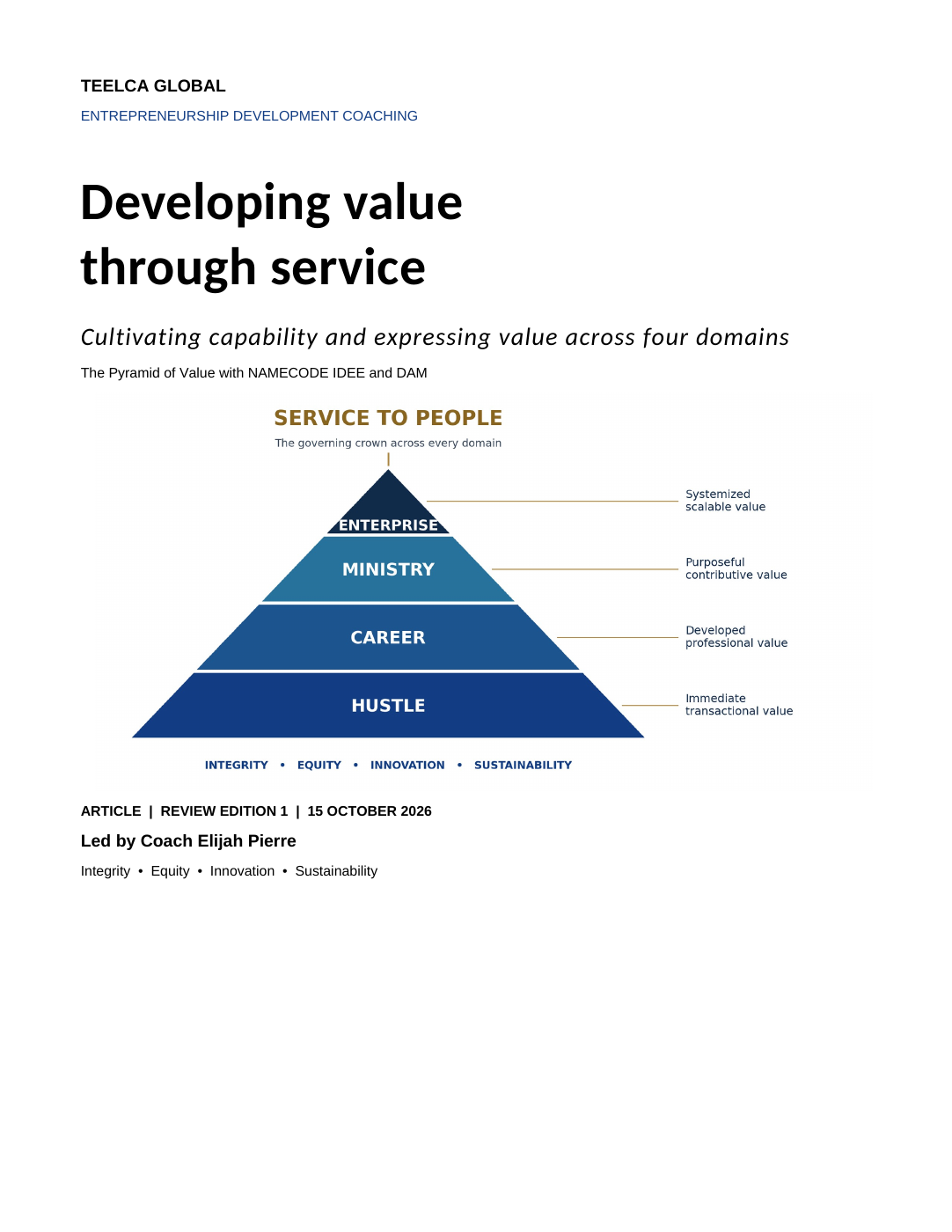
Value begins with a person and reaches another person
By Coach Elijah Pierre | TEELCA Global
Entrepreneurship development begins with a practical question: what can you develop in yourself that will make a meaningful difference to someone else? A gift, skill or experience becomes useful when it meets a real need through dependable action. My Pyramid of Value provides a way to examine where that contribution is expressed and what must be developed next.
This article brings selected themes from Dr. Myles Munroe’s teaching into conversation with my coaching methodology. The resulting business applications are TEELCA’s synthesis. The Pyramid of Value, NAMECODE, IDEE and DAM are attributed to Coach Elijah Pierre; Munroe is credited for the specific ideas referenced below.
What we mean by value
For this coaching process, human worth is inherent. It does not rise and fall with income, employment status or business ownership. Capability is the ability to perform a task. Expressed value is the useful contribution that capability delivers to people. Commercial value concerns an offer for which a customer is willing and able to exchange resources. Ethical values govern how that contribution is created and delivered.
These distinctions matter. A caregiver may create substantial value without receiving a market payment. A highly skilled person may need access, tools or opportunity before that skill produces income. A profitable offer may still damage trust if its promises or working conditions are unfair. We therefore assess benefit, conduct and economic viability together.
What Munroe contributes
In the publisher article Diamonds in the Rough, Munroe writes, “God can bring beauty out of your mistakes.” His emphasis is on the possibility of restoration and potential beyond a damaged past. For coaching, this supports an examination of present capacity without allowing past setbacks to define the whole person. [S1]
Munroe Global’s description of Success With Purpose and Power connects success with fulfilling purpose and serving gifts to others. In his article on Christian singleness, the sections on work, cultivation and protection connect meaningful activity with bringing capacity into expression. The practical implication I draw is to develop ability through real tasks and judge its usefulness by the people it serves. [S2, S3]
The Pyramid of Value
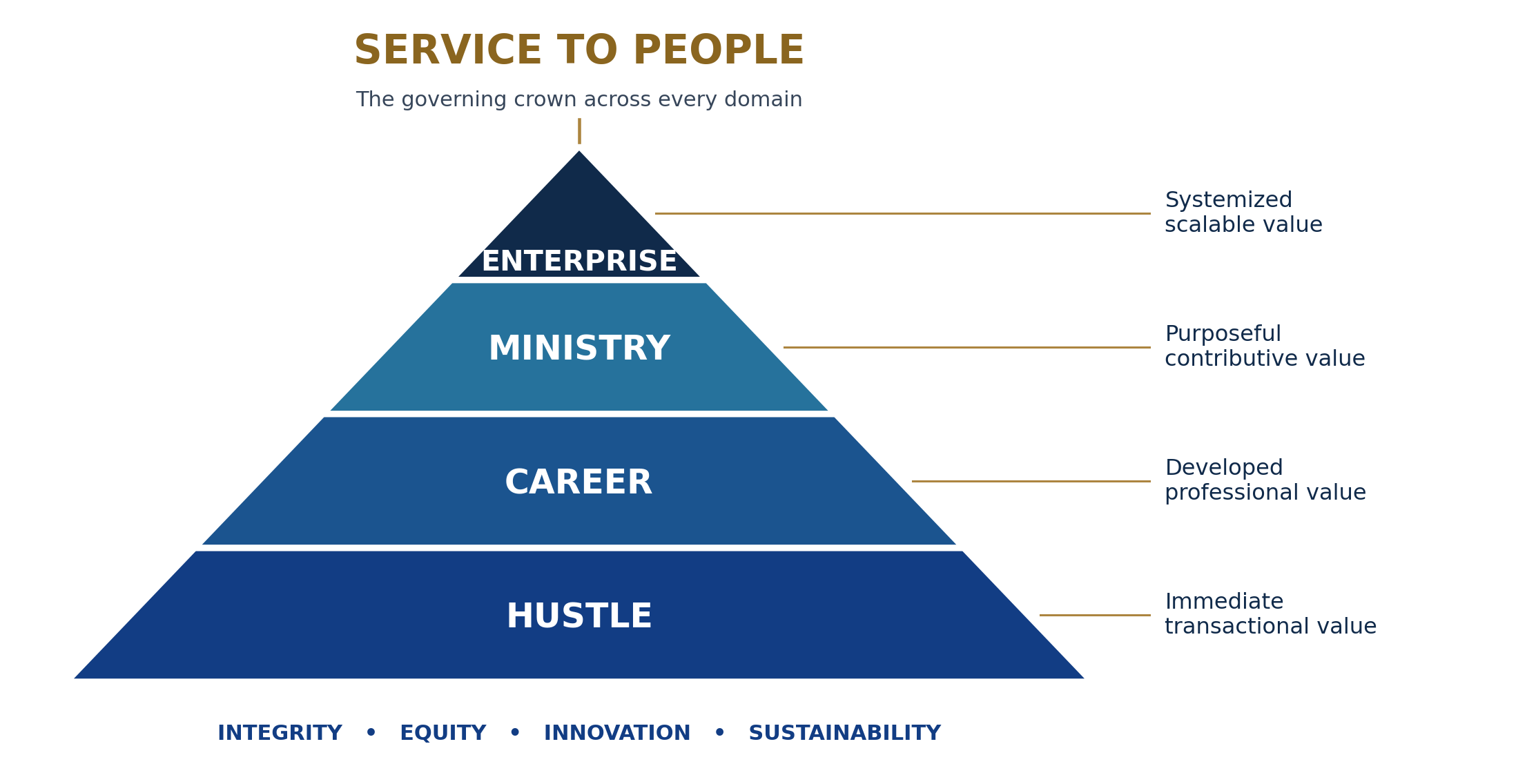
The four domains are arranged from the base upward as Hustle, Career, Ministry and Enterprise. Service to People is their governing crown. It is not a fifth domain. The pyramid examines the maturation of value expression, including the responsibility carried for the people served.
Hustle
Immediate transactional value meets a current need through a task or sale. Development begins with clearer scope, safer delivery, honest pricing and a record of results. Survival constraints deserve practical support.
Career
Developed professional value rests on dependable competence through employment, a profession or skilled independent practice. Development strengthens skill, standards and evidence of performance so contribution becomes more reliable and visible.
Ministry
Purposeful contributive value directs ability toward a meaningful human need, including faith service and wider contribution. Development connects purpose with competence, boundaries and accountability. Meaningful service can be paid or unpaid.
Enterprise
Systemized, scalable value coordinates people, processes and resources for repeatable delivery. Development makes service dependable beyond the founder’s effort while protecting quality, fairness and continuity. Registration alone does not establish this maturity.
People may express value in several domains at once. The model offers a developmental sequence; the next responsible step depends on evidence, readiness and circumstances.
The principles beneath the contribution
The four domains describe where value is expressed. My four governing principles describe how that expression should be built. They apply from the first transaction to the systems of an established enterprise.
| Principle | A practical commitment | Evidence to look for |
|---|---|---|
| Integrity | State what you can deliver and make your terms clear. | An accurate offer, a scope agreement and a record of delivery. |
| Equity | Consider who can participate, who benefits and who carries the burden. | Clear access arrangements, fair treatment and a route for feedback. |
| Innovation | Improve the way a genuine problem is solved. | A small test compared with the customer’s current alternative. |
| Sustainability | Protect the people and resources needed for continued service. | A workable workload, realistic costs and a documented process. |
Whitaker House’s description of The Power of Character in Leadership emphasizes that talent alone does not preserve trust or enduring influence. I apply this to entrepreneurship by making character visible in promises, standards and corrective action. Skill attracts attention; responsible conduct helps a relationship endure. [S4]
A priestly stewardship lens
Within the Christian and Hebrew scriptural orientation of my coaching practice, ability is entrusted for responsible service. Genesis 2:15 presents work as cultivation and keeping. Exodus 31:1-5 connects craftsmanship with wisdom, understanding and skilled work. Leviticus 19:35-36 calls for honest measures. First Peter 4:10 connects received gifts with service to one another.
I use these passages as a theological lens for disciplined practice: develop what is entrusted, protect what is affected, deal honestly and make contribution useful to others. This is a coaching interpretation of those passages. It supports clear business questions about quality, dignity and stewardship rather than a prediction of commercial success.
Put the principles into a difficult decision
Imagine a customer asking for an order sooner than your team can responsibly complete it. Integrity requires an honest delivery promise. Equity asks whether staff or other customers would carry an unfair burden. Innovation invites a smaller or staged solution. Sustainability checks the workload and cost. The principles become operational when they change the decision.
Developing the person and the vehicle
NAMECODE helps clarify the person’s capacity and direction. IDEE organizes development into action. DAM examines the beliefs and structures behind recurring outcomes. The Pyramid of Value locates current expression and the next development priority. Together, they connect identity, capability, service and delivery.
Apply the seven NAMECODE dimensions
| Dimension | Question for developing value |
|---|---|
| Nature | What tendencies and strengths appear repeatedly in my actual work? |
| Title | What role accurately describes the responsibility I can carry now? |
| Function | What useful actions can I perform, and what evidence supports them? |
| Purpose | Whose condition should improve, and why does that matter? |
| Essence | Which governing qualities must remain visible in my conduct? |
| Designation | In which field, setting or assignment can this capacity serve? |
| Identity | What accountable description connects who I am with how I serve? |
These are applied coaching prompts. A profile should be supported by examples, feedback and observable performance. A promising description becomes useful when it guides a task that can be tested.
Move through IDEE
Identify the capacity, the people and the need. Develop the missing skill through deliberate practice and feedback. Equip the person with the tools, knowledge and operating arrangements needed to deliver. Express the value through a real, bounded offer or service. Review the result and use the evidence to inform the next cycle.
Use DAM where the same difficulty keeps returning
Deconstruct the recurring outcome: what happened, what assumption governed the decision, and what practical constraint was present? Align the decision with purpose, people and the four principles. Manifest the alignment through a specific action and a review date. If someone repeatedly underprices, the work may involve both a belief about worth and a missing cost record; each needs its own response.
From an ability to an offer that can be tested
Consider an illustrative home caterer. Occasional meal orders express transactional value. Training, consistent recipes and dependable food preparation develop professional value. A purposeful commitment to busy households gives service a clearer human focus. An ordering process, documented standards and a capable team can support enterprise expression. These expressions can coexist.
The starting question is concrete: which households face which meal problem, how do they manage it now, and what would a useful improvement look like? The caterer interviews potential customers before committing to a large menu or expensive equipment. A small pilot then tests a limited offer, such as five weekday lunches with a defined collection arrangement.
The pilot records the number of complete and timely orders, customer feedback, waste, time used and actual costs. These observations matter more than enthusiastic compliments. A price discussion also matters: a need may be real even when the intended beneficiary cannot pay. In that case, the model may require a different scope, a sponsor or a different customer.
Steward the resources already present
In 7 Tips for Managing a Crisis, Munroe encourages readers to reconsider the usefulness of resources they already possess. Applied here, the question becomes: what can be tested responsibly with the skills, equipment and relationships already available? The business test remains our application, not a guarantee contained in the teaching. [S5]
Build continuity into the service
Munroe Global’s description of Passing It On highlights mentoring and the development of people who can carry a vision forward. For enterprise development, I apply this by asking participants to document one critical process and teach another person how to perform it to an agreed standard. Continuity begins with deliberate transfer. [S6]
A first month of value development
| Period | Action | Evidence |
|---|---|---|
| Week 1 | Complete a capacity profile and speak with three intended customers. | Examples of ability and notes on a repeated problem. |
| Week 2 | Practice one missing skill and define a bounded offer. | A work sample, clear terms and a cost estimate. |
| Week 3 | Deliver one small pilot with informed agreement. | A delivery record, actual costs and user feedback. |
| Week 4 | Review the result and document the next version. | A decision to refine, repeat, redirect or pause. |
Developing value means becoming more capable of serving a real need with integrity and consistency. The next step is to identify one contribution, one group of people and one practical improvement that can be tested. That is the work our entrepreneurship development workshop is designed to begin.
References and attribution
S1 Myles Munroe. Diamonds in the Rough. Destiny Image article.
S2 Munroe Global. Success With Purpose and Power A 90 Day Devotional. Official book description.
S3 Myles Munroe. God’s Plan for Christian Singles 7 Steps to Make the Most Out of Your Singleness. Destiny Image article sections Work Cultivate and Protect.
S4 Whitaker House. The Power of Character in Leadership. Publisher description of Myles Munroe’s book.
S5 Myles Munroe. 7 Tips for Managing a Crisis. Destiny Image article section Value Your Possessions.
S6 Munroe Global. Passing It On. Official book description.
Sources accessed 15 October 2026. Official descriptions are identified as descriptions; they are not presented as book passages. Dates of online republication are not dates of original delivery.
TEELCA methodology sources
Coach Elijah Pierre, Life and Business Coaching Portfolio, 2026, especially pages 5-6; Leadership and Governance Development Executive Portfolio, 2026, especially pages 5 and 8. These supplied portfolios ground the four practice principles, NAMECODE, IDEE and DAM. The four-domain order and Service to People crown follow Coach Elijah Pierre’s previously established Pyramid of Value.
Authorship
Pyramid of Value, NAMECODE, IDEE and DAM: Coach Elijah Pierre, TEELCA Global. Article language and applied examples are prepared for Coach Elijah Pierre’s review. References to Dr. Myles Munroe acknowledge selected published teaching and official descriptions; they do not imply affiliation or endorsement.
Scripture references are provided for the stated theological application. The workshop and article use paraphrase unless quotation marks are shown.