How the mind shapes wealth
Generational wealth begins, in part, with the reference point that governs how we use what we have. Before a person makes a financial decision, that person interprets what money means, who they believe they are, what they fear losing, and what they consider worth protecting. These judgments influence whether wealth becomes a means of service and continuity or a source of control and harm.
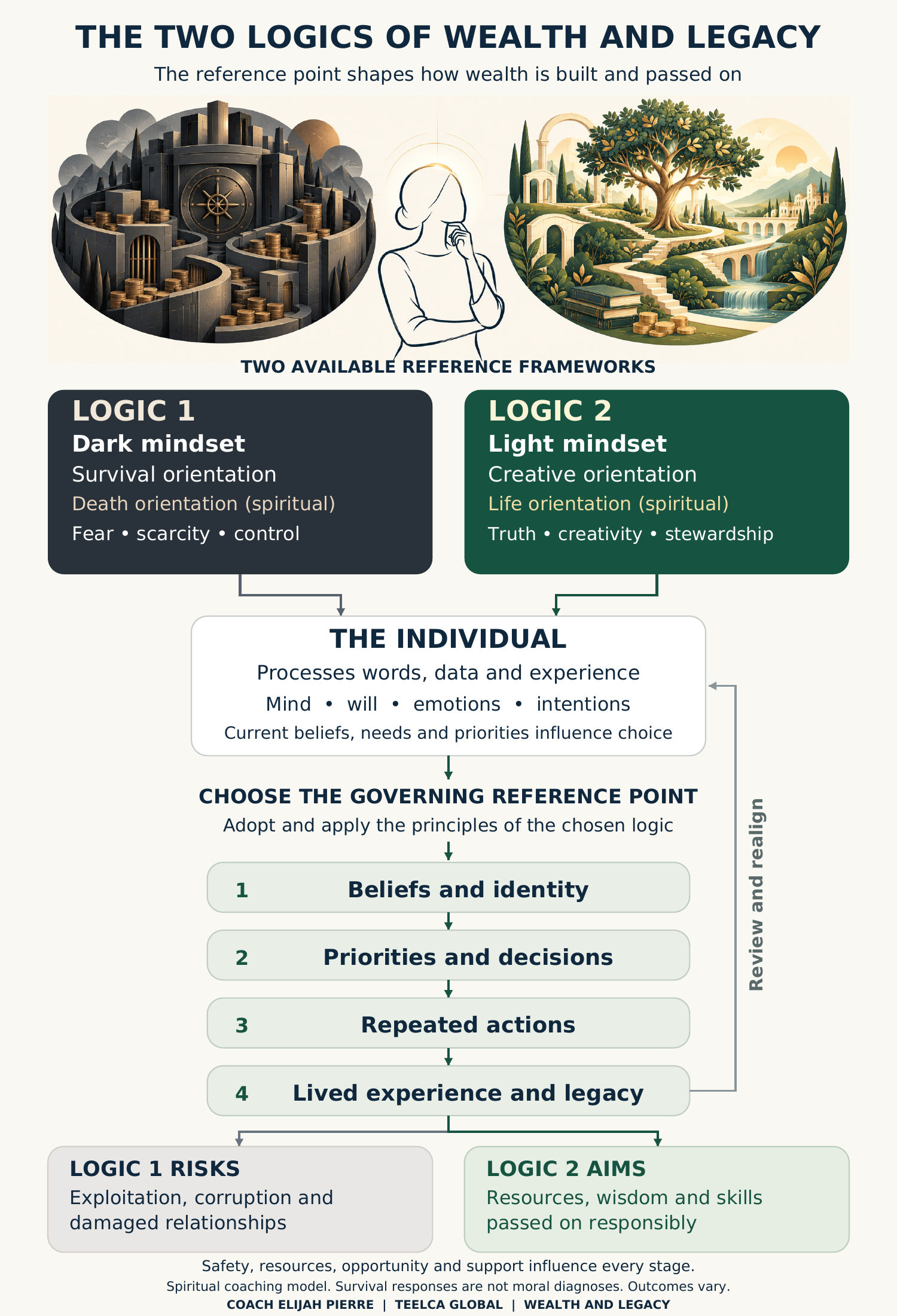
What enters the mind can become part of lived experience. Words, teaching, examples, relationships and repeated experiences supply information. We interpret that information, accept or question its assumptions, and form beliefs. Beliefs influence identity and priorities; priorities influence decisions; repeated decisions establish practices. Those practices help shape what our families experience and what the next generation inherits. This is a developmental pathway, not a claim that thoughts alone cause every event.
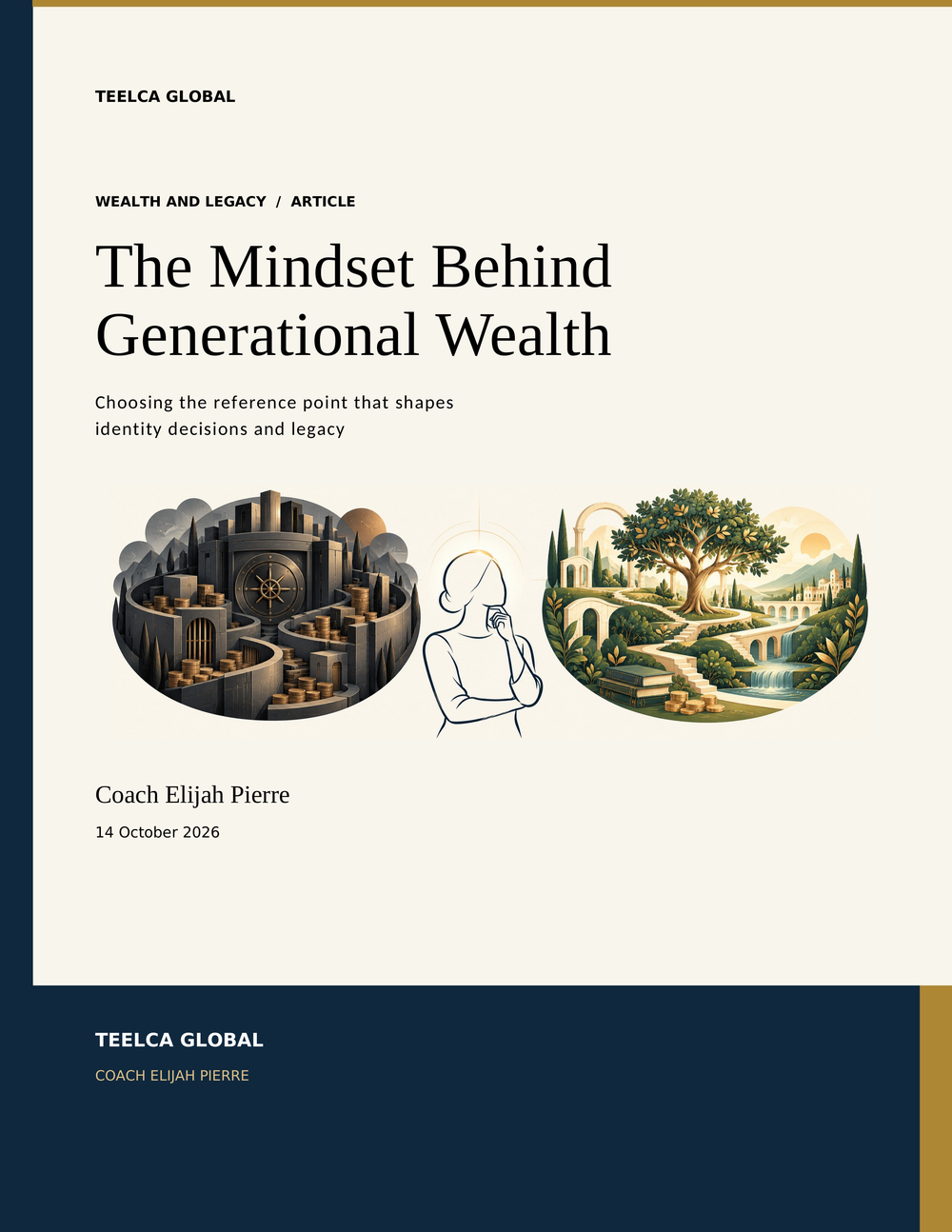
In this article, I describe two governing orientations. Logic 1 is the dark mindset: an orientation in which fear, scarcity, control or self-preservation can become the highest authority. I use death as its spiritual description when this orientation legitimizes conduct that diminishes life. Logic 2 is the light mindset: an orientation governed by truth, responsible creativity and stewardship. I use life as its spiritual description because its aim is to cultivate what allows people and future generations to flourish.
The individual is distinct from both frameworks. The person receives and processes words, data and experience through reasoning, will, emotion and intention. The person can examine both orientations and choose which principles will govern a particular decision. Existing beliefs, current needs and learned priorities influence that choice. Once adopted, the reference point also reshapes future beliefs and priorities. The relationship is a feedback loop, and alignment must be renewed through practice.
The spiritual and psychological lenses
These are categories in my spiritual coaching model. Survival and creative mindsets offer useful psychological parallels, but psychology does not universally classify people into these two groups, and pneumatology does not reduce the Holy Spirit to a positive mental state. Romans 8:6 places life and peace within life governed by the Spirit; its context is broader than financial prosperity. [1]
Deuteronomy 30:19-20 connects choosing life with covenant faithfulness and the wellbeing of descendants. Read through the priestly lens used here, the question is what we are entrusted to preserve, cultivate and pass on. Romans 12:2 also connects renewal of the mind with discernment. These passages provide the spiritual foundation for this application to wealth; they do not establish a scientific two-mindset theory. [2], [3]
Wealth under Logic 1
Under Logic 1, wealth is pursued as proof of worth or protection from vulnerability. The governing question becomes how to secure more before someone else takes the opportunity. A person may accumulate substantial assets while remaining unable to rest, trust, share responsibility or feel secure. Financial reward can increase the pressure to defend status rather than resolve the fear beneath it.
When self-preservation overrides accountability, wealth can be built through exploitation, concealment or corruption. Employees become disposable, customers become targets, and family members become instruments of succession. A business may grow while its relationships deteriorate. The balance sheet records the assets, but it does not record all the human costs of acquiring or preserving them.
The legacy may therefore include both money and harmful patterns. Children can inherit secrecy, mistrust, entitlement, rivalry or the belief that success excuses wrongdoing. In the spiritual language of this framework, death names the destruction of trust, dignity, relationship and responsibility. Material accumulation does not make those losses harmless.
This distinction must be applied with care. Survival responses can protect people during real danger, and financial insecurity can constrain their choices. Feeling afraid, needing income or experiencing poverty does not make a person corrupt. The concern is allowing fear or gain to authorize harm. Research on stress describes how uncontrollable stress can impair the reflective functions of the prefrontal cortex; the same protective responses can be useful when rapid action is needed. [5]
Wealth under Logic 2
Under Logic 2, wealth is developed as a resource entrusted to a steward. The governing questions concern what value we can create, whom our decisions affect, and whether the work can continue responsibly after us. Financial reward remains important: it supports households, compensates work and sustains enterprise. Its purpose is kept accountable to life.
Integrity requires honest dealing and records that can withstand scrutiny. Equity requires fair treatment and a reasonable distribution of opportunity and responsibility. Innovation develops useful solutions to real needs. Sustainability protects the people, resources and capabilities on which future value depends. These principles must appear in contracts, working conditions, spending decisions and family practices.
Logic 2 gives a reason to continue producing value after financial reward has been attained. The purpose of the work includes developing people, solving worthwhile problems and equipping successors. Money can fund that purpose without becoming the sole measure of identity. A family can enjoy its resources while teaching the judgment needed to preserve and use them.
Choosing the reference point
The practical task is to identify what already governs a decision. Consider a business owner whose sales have fallen. A fear-governed response may rationalize hidden charges, dishonest promises or shifting avoidable costs onto employees. A life-governed response can still act urgently: investigate the problem, communicate honestly, reduce waste and develop an offer that serves customers better. Both responses seek income; the governing principle changes the means considered acceptable.
A reference point becomes credible through conduct. Saying that we value stewardship while refusing transparency leaves our declared belief disconnected from our practice. Alignment means that beliefs, identity, priorities and actions become coherent. The frequency language sometimes used for this relationship is a metaphor for alignment, not a measurable force that causes money or circumstances to obey thought.
Psychological research offers a limited parallel. In two experiments involving 104 college students, Fredrickson and Branigan found that induced positive emotions broadened attention or the range of actions participants considered, compared with a neutral condition. The findings help explain why an emotionally resourced person may see more options. They do not prove that creativity produces ethical conduct or guarantees generational wealth. [6]
Identity through NAMECODE
NAMECODE helps us connect a chosen reference point with personal identity. Its dimensions are Nature, Title, Function, Purpose, Essence, Designation and Identity. [7] Applied here, they invite a person to examine their capacities, the role they occupy, what they actually do, why the work matters, the qualities that must remain trustworthy, the responsibilities entrusted to them, and the self-understanding expressed in action.
For example, a parent may hold the title of business owner while understanding their function as creating useful employment and preparing successors. Their purpose can include family provision and community value. Their responsibilities then require both capable management and fair treatment. This use of NAMECODE is an application of the framework to stewardship, not a promise that naming an identity will produce the desired outcome.
Legacy requires transferable capacity. It includes skills, reliable records, sound judgment, clear responsibilities and relationships that can sustain cooperation. An inheritance becomes more useful when its recipients know how to manage it. The next generation should receive both resources and the ability to use those resources responsibly.
Building wealth that protects life
The aim of Logic 2 is wealth developed without corruption, exploitation or preventable destruction. It is wealth that can be enjoyed with a clear conscience and entrusted to others responsibly. This does not mean that faithful or ethical people will experience no pain, loss, conflict or uncertainty. Romans 8 itself recognizes suffering. The commitment is to avoid making harm the method of prosperity and to respond responsibly when hardship occurs. [1]
Proverbs 10:22 associates wealth with the blessing of the Lord and speaks of the absence of painful toil in the NIV rendering. Within this article, it supports reflection on the quality and source of prosperity. It is not treated as a contractual guarantee that every financial result will be favourable or that a person who suffers has chosen the wrong mindset. [4]
Changing the reference point therefore requires both inner examination and practical systems. A household or business needs skills, trustworthy information, sufficient resources and opportunities to act. Access to safety, education, fair markets and supportive relationships influences what is possible. Responsible coaching strengthens agency while recognizing these conditions.
Five practices for alignment
- Examine the input. Identify the messages and experiences teaching you what money, success and security mean. Test them for truth and usefulness.
- Name the governing belief. Write the assumption beneath one recurring decision. Distinguish a real constraint from a belief that excuses avoidable harm.
- Adopt a life-serving principle. Choose a specific principle of integrity, equity, innovation or sustainability to govern that decision.
- Build a matching practice. Translate the principle into an observable action, such as transparent pricing, a weekly financial review, fair allocation of responsibilities or teaching a child a useful skill.
- Review the fruit. Assess both financial results and effects on people. Keep what serves life, repair harm where possible, and revise the approach when evidence requires it.
Choosing Logic 2 is an ongoing responsibility. The individual examines the reference point, forms beliefs that support it, and expresses those beliefs through competent action. Over time, those practices can build resources and relationships worth passing on. Generational wealth becomes a living inheritance when the next generation receives the means to prosper and the wisdom to steward what it receives.
The two logics of wealth and legacy
Sources and framework notes
Scripture supports the spiritual interpretation; research supports specific psychological parallels. The two-logics model is presented as Coach Elijah Pierre’s coaching framework.
- Romans 8:6 and 8:17-26, New International Version. Life through the Spirit and the chapter's recognition of suffering. Read the source
- Deuteronomy 30:19-20, New International Version. Choosing life in its covenant context and concern for descendants. Read the source
- Romans 12:2, New International Version. Renewal of the mind and discernment. Read the source
- Proverbs 10:22, New International Version. Wealth, blessing and painful toil. See also translation variation; the verse is used here for spiritual reflection. Read the source
- Arnsten, A. F. T. (2009). Stress signalling pathways that impair prefrontal cortex structure and function. Nature Reviews Neuroscience, 10(6), 410-422. DOI 10.1038/nrn2648. See also the Arnsten Lab account of protective and detrimental stress responses. Read the source
- Fredrickson, B. L., and Branigan, C. (2005). Positive emotions broaden the scope of attention and thought-action repertoires. Cognition and Emotion, 19(3), 313-332. DOI 10.1080/02699930441000238. Two experiments with 104 college students; no test of wealth or moral character. Read the source
- Coach Elijah Pierre. Life and Business Coaching Portfolio, p. 6; Leadership Governance Development Executive Portfolio 2026, p. 8. Supplied practice documents defining NAMECODE, DAM and reference-point questioning.
- Additional primary context for source 5: Arnsten Lab research explanation at Yale.