In this article
- Introduction: The Misunderstanding of Abundance
- 1. The Principle of Increase: Everything Begins with Measurement
- 2. The Principle of Net Increase: What Comes In Must Exceed What Goes Out
- 3. The Principle of Abundance: Plenty Is Not Always Prosperity
- 4. The Scarcity Mindset: When Preservation Becomes Imprisonment
- 5. The Principle of Multiplication: Your Resources Must Become Productive
- 6. The Principle of Wealth Engines: Building Beyond a Single Income
- 7. The Principle of Proliferation: When Wealth Begins to Expand Beyond You
- 8. The Relationship Between Wealth and Identity
- Conclusion: Stop Chasing Abundance. Start Governing Increase.
Introduction: The Misunderstanding of Abundance
One of the greatest misconceptions people have about wealth is the belief that abundance begins with having plenty.
People pursue higher salaries, larger bank accounts, greater possessions, and more financial opportunities because they believe these things will eventually bring them into a condition of abundance.
But I want to challenge that thinking.
Abundance does not begin with having plenty. Abundance begins with understanding the principle of increase.
Until a person understands how increase operates, how it is measured, how it is sustained, and how it can be multiplied, that individual may spend an entire lifetime pursuing abundance without ever experiencing its benefits.
You can earn a substantial salary and still struggle financially. You can have hundreds of thousands of dollars in your bank account and still operate with a scarcity mindset. You can accumulate significant resources and yet possess very little capacity to reproduce them.
This is why we must distinguish between four fundamental concepts: Increase, Abundance, Multiplication, and Proliferation.
1. The Principle of Increase: Everything Begins with Measurement
Imagine having a cup containing six millilitres of water.
Now imagine placing one additional drop of water into that cup.
What has happened?
An increase has occurred.
It does not matter that the increase was small. It does not matter that the cup is nowhere near full. What matters is that the quantity of water has moved beyond its previous measurement.
That single drop represents the principle of increase.
Increase is the measurable positive difference between a previous condition and a present condition.
This teaches us something important: increase does not have to be large to be meaningful.
Many people overlook small increases because their attention is fixed on achieving something substantial. They fail to recognize that every substantial accumulation begins with an initial increase.
The person who learns to recognize, measure, and consistently produce increase has established the foundation upon which abundance can be developed.
2. The Principle of Net Increase: What Comes In Must Exceed What Goes Out
Now consider something else.
Suppose you continuously pour water into a container, but the container has an opening through which water escapes.
You may pour ten litres into that container, but if twelve litres escape during the same period, you have not experienced an increase in stored water.
You have experienced depletion.
The same principle applies to personal finances.
A person may earn TT$20,000 monthly, but if that person spends TT$19,800, the remaining surplus is only TT$200.
Another person may earn TT$10,000 monthly and spend TT$7,000, leaving TT$3,000.
The first individual earns more money, but the second produces a greater monthly surplus.
This reveals a governing principle:
Your financial increase is not determined by how much money enters your possession, but by the relationship between what enters, what leaves, and what remains or is productively deployed.
The basic formula is:
Net Increase = Total Inflow − Total Outflow
This is why earning more money does not automatically solve financial problems.
If expenditure increases at the same rate as income, the individual may experience greater financial activity without experiencing greater financial progress.
Before pursuing abundance, we must first establish the discipline and systems required to produce sustainable net increase.
3. The Principle of Abundance: Plenty Is Not Always Prosperity
Abundance develops when increase is consistently sustained over time.
But there is an important distinction between possessing plenty and operating in sustainable abundance.
Imagine a person who has accumulated one million dollars.
That individual may have spent twenty years saving, restricting expenditure, avoiding unnecessary purchases, and protecting every dollar.
From the perspective of storage, this individual possesses substantial resources.
However, what happens if the person's only source of income disappears?
What happens when major financial responsibilities arise?
What happens when inflation reduces purchasing power or unforeseen circumstances require significant expenditure?
The accumulated reserve begins to decrease.
This exposes a critical weakness.
A person can possess substantial financial storage while having limited financial production capacity.
The bank account may be large, but the system responsible for replenishing that account may be small.
I call this the distinction between stored abundance and productive abundance.
Stored abundance describes the resources accumulated.
Productive abundance describes the capacity to continue generating resources while meeting present and future responsibilities.
Both are valuable. However, a financial system that depends exclusively on stored resources remains vulnerable to depletion.
4. The Scarcity Mindset: When Preservation Becomes Imprisonment
There is another governing mindset that deserves our attention.
Some individuals become so concerned about losing money that they develop an unhealthy relationship with expenditure.
They monitor their bank accounts constantly. They become distressed whenever their balances decrease. They may feel guilty about making necessary purchases or become reluctant to invest in opportunities that could strengthen their productive capacity.
For some, these behaviours may be connected to previous experiences of financial hardship, insecurity, or loss.
Now, let me establish something important.
There is absolutely nothing wrong with financial discipline, moderation, or responsible saving.
In fact, these practices are necessary.
The problem begins when preservation becomes the governing purpose of financial existence.
A person may become so committed to protecting what has been accumulated that they neglect opportunities for development, education, enterprise, appropriate comfort, and improved quality of life.
They begin measuring their personal worth by the amount of money sitting in an account.
When the account increases, they feel successful.
When the account decreases, they feel diminished.
But your identity should never be determined by your bank balance.
Money is a resource entrusted to your management. It is not the measurement of your human value.
The objective is not to spend recklessly or pursue extravagant appearances. Neither is it to deprive yourself unnecessarily.
The objective is to develop the wisdom to distinguish between consumption, preservation, and productive deployment.
5. The Principle of Multiplication: Your Resources Must Become Productive
This brings us to the principle of multiplication.
Increase and multiplication are related, but they do not perform the same function.
Increase adds to what already exists.
Multiplication establishes the possibility of producing more through the productive use of existing resources.
Consider the difference between saving TT$1,000 every month and developing a business system that can generate additional income.
Saving strengthens financial reserves.
A well-managed, profitable business may strengthen financial production capacity.
The first increases what you possess.
The second can increase what your resources are capable of producing.
This is why multiplication must become part of our wealth-development philosophy.
A person who understands multiplication begins asking different questions.
Instead of asking only, "How much money do I have?" the person begins asking, "What productive capacity can I develop with the resources available to me?"
Instead of asking only, "How much can I save?" the person begins asking, "How can I responsibly convert a portion of my resources into assets, capabilities, or systems that generate additional value?"
Multiplication is not guaranteed. Every investment or enterprise carries risk, and some may produce losses rather than returns.
Nevertheless, the governing concept remains:
Wealth development requires more than accumulation. It requires the intelligent development of productive capacity.
6. The Principle of Wealth Engines: Building Beyond a Single Income
A wealth engine is a productive mechanism capable of generating economic value or income.
It may take the form of a business, an income-producing asset, intellectual property, a professional service, or another responsibly structured source of revenue.
Consider an individual whose entire financial life depends upon one salary.
That salary must support living expenses, family responsibilities, savings, emergencies, and future ambitions.
Even if the salary is substantial, the person remains dependent upon one primary income engine.
Now consider what becomes possible when that individual gradually develops additional productive systems.
Professional expertise may become a consulting service.
Specialized knowledge may become an educational programme.
A practical solution may become a product.
An established business may eventually develop additional divisions.
Each successful development has the potential to create another avenue through which value can be produced.
This does not mean everyone must immediately start several businesses. Building too many ventures without adequate resources can increase financial risk.
It means understanding that long-term financial resilience can be strengthened by developing productive capacity beyond a single source of income.
7. The Principle of Proliferation: When Wealth Begins to Expand Beyond You
Multiplication leads us to a further concept: proliferation.
Proliferation occurs when productive systems expand, reproduce, or give rise to additional expressions of value.
An entrepreneur establishes a functioning business.
That business develops reliable systems, employees, customers, and sustainable operations.
Over time, the enterprise may create additional products, establish new locations, support other enterprises, or develop further income-producing assets.
The original productive system has now become the foundation for wider economic activity.
This is the principle of proliferation.
It is no longer simply about accumulating more money.
It is about developing systems that can create value beyond the direct labour and immediate presence of the individual.
Within wealth and legacy development, this distinction is essential.
A financial reserve may support a family for a period.
A responsibly governed productive enterprise may create opportunities, employment, services, and economic contributions across generations.
That is the potential of proliferation.
8. The Relationship Between Wealth and Identity
There is a final dimension to this philosophy that I consider fundamental.
A person's identity must not become imprisoned within the measurement of their possessions.
When we define ourselves exclusively by what we have accumulated, we begin to confuse ownership with personal worth.
But wealth should be understood through a broader developmental perspective.
What knowledge have you developed?
What abilities can you express?
What problems can you solve?
What systems can you establish?
What value can you contribute to other people?
What legacy can emerge from the responsible expression of your capabilities?
These questions redirect our attention from possession alone toward purpose, function, capacity, and contribution.
The objective is not merely to become someone who has wealth.
It is to become someone who understands how to identify, develop, manage, and express value responsibly.
Conclusion: Stop Chasing Abundance. Start Governing Increase.
If there is one lesson I want you to take away from this article, it is this:
Do not make abundance your first pursuit. Make the principle of increase your first discipline.
Learn to measure your present condition.
Understand the relationship between inflow and outflow.
Establish sustainable net increase.
Develop financial reserves.
Learn the distinction between preservation and productive deployment.
Build the knowledge, skills, and systems necessary for responsible multiplication.
Then begin developing productive mechanisms capable of expanding beyond your immediate personal effort.
The developmental sequence is simple:
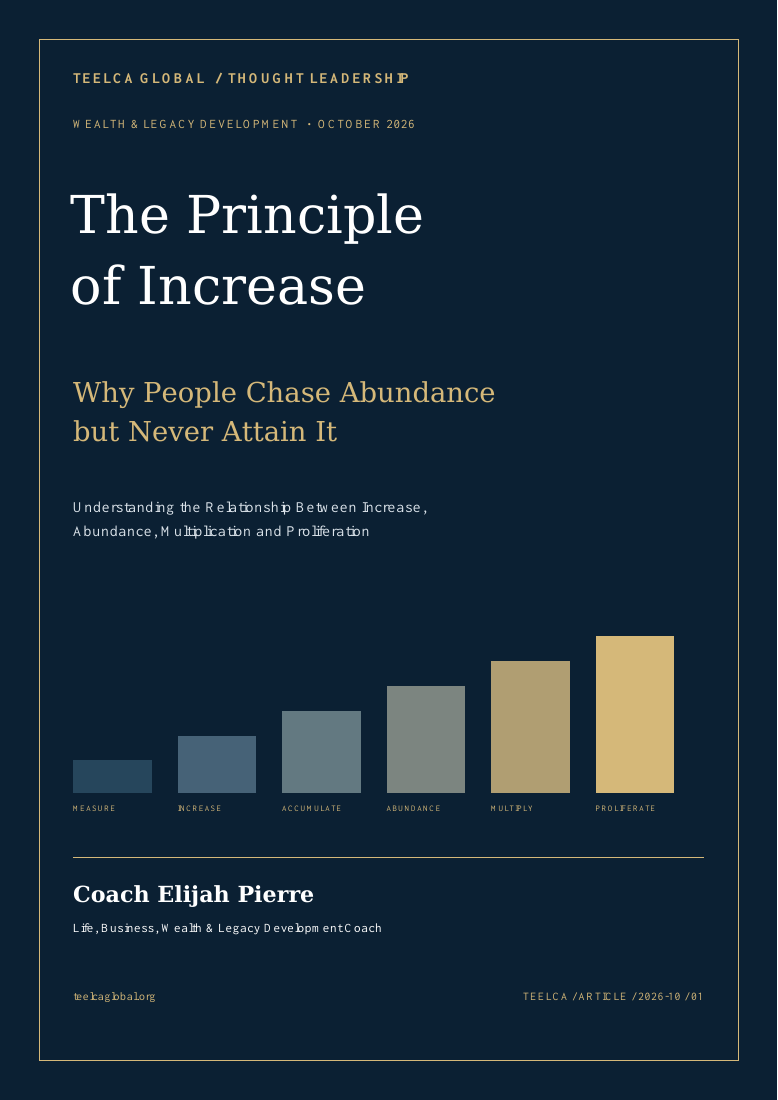
Measurement → Increase → Accumulation → Abundance → Multiplication → Proliferation
These stages are interconnected, and in practice they may overlap or repeat as your circumstances develop.
Remember:
Increase is the process. Abundance is the condition. Multiplication is the mechanism. Proliferation is the expansion of productive capacity.
The greatest question is not simply how much wealth you possess today.
The greater question is:
What have you developed that is capable of producing value tomorrow?
About the Author
Coach Elijah Pierre is a Life, Business, Organizational, Wealth & Legacy Development Coach and founder of TEELCA Global. His developmental approach focuses on identifying, developing, equipping, and expressing human potential through structured coaching, education, entrepreneurship, and value cultivation.
TEELCA Global — Changing the Economic Landscape of People and Organizations.
© 2026 Coach Elijah Pierre. All rights reserved.